Not sure whether your laboratory needs a LIMS or a document management system? Learn the differences, where they overlap, and how each supports compliance, quality management, and operational efficiency.

Laboratories generate more than test results. They also create and manage SOPs, quality records, training documentation, calibration certificates, equipment manuals, vendor records, invoices, and audit reports—all of which keep daily operations running smoothly.
As laboratories grow, so does the challenge of managing that information. In fact, research from Harvard Business Review found that knowledge workers spend 21% of their time searching for information, and an additional 14% recreating work they can’t find. While laboratory professionals spend much of their day testing samples and reviewing results, time spent searching for procedures, calibration records, or quality documentation can slow productivity and make audit preparation more difficult.
Many organizations turn to software to solve these challenges, and often encounter two solutions that sound similar but serve very different purposes: Laboratory Information Management Systems (LIMS) and Document Management Systems (DMS).
Both help organize information, but they solve different business problems. Choosing the right solution—or combination of solutions—can simplify compliance and ensure your team spends less time searching for information and more time on productive work This guide explains what each system does, where they overlap, and when your organization may benefit from one or both.
A Laboratory Information Management System (LIMS) is software designed to manage laboratory operations, particularly the lifecycle of samples from receipt through testing, analysis, reporting, and storage.
Think of a LIMS as the operational hub of a laboratory. It helps standardize processes, reduce manual data entry, improve traceability, and maintain accurate records throughout testing.
A typical sample might move through a LIMS like this:
Rather than relying on spreadsheets, handwritten notes, or disconnected software, a LIMS creates a centralized workflow that improves consistency and helps labs meet regulatory requirements.
LIMS software is common in industries where laboratories play a central role in operations or regulatory compliance: pharmaceutical manufacturing, biotechnology, clinical and medical labs, environmental testing, food and beverage safety, chemical manufacturing, cannabis testing, forensic science, and academic research. For these organizations, a LIMS becomes the system of record for samples, testing workflows, and analytical results.
While a LIMS focuses on laboratory operations, a document management system (DMS) focuses on the documents that support those operations—and often the entire organization.
A DMS provides a secure, central place where businesses can store, organize, search, and control digital documents. Instead of information being scattered across filing cabinets, shared drives, email inboxes, and individual computers, everything lives in one searchable location with appropriate security and version control.
Document management for laboratories typically includes SOPs, quality manuals, validation documentation, training records, equipment manuals, calibration certificates, vendor contracts, Safety Data Sheets (SDS), audit documentation, purchasing records, invoices, and HR files. Unlike a LIMS, which is primarily used by laboratory personnel, a DMS supports departments across the organization—quality assurance, finance, purchasing, operations, HR, and executive leadership.
These capabilities help organizations reduce paper, improve collaboration, protect sensitive information, and ensure employees always have access to the latest approved documents. For laboratories, a DMS often becomes the central repository for controlled documentation that falls outside day-to-day sample management.
Both systems organize information, improve traceability, and support compliance and audit trails—which is why they're often confused. But they're built for fundamentally different purposes:
Neither is inherently better; they are complementary and solve different problems.
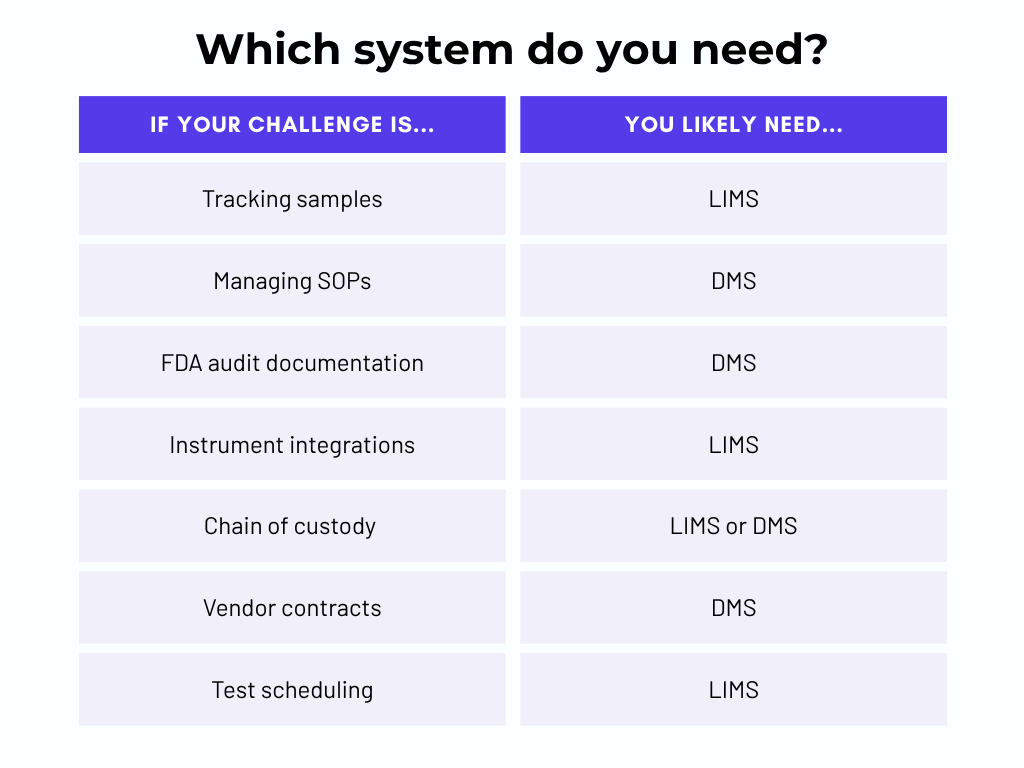
The distinction is clearest in the questions each system is built to answer. A LIMS answers questions like where is this sample? or what instrument generated these results? A DMS answers questions like which version of this SOP is current? or who approved this procedure?
For many organizations, this isn't an either-or decision.
A LIMS and a DMS solve different challenges, which is why they often work best together.
The LIMS manages laboratory operations, but document management for laboratories controls the documents that support those operations and the broader business—from procedures and quality records to vendor documentation and employee training files.
Over the years, we've worked with laboratories, water testing agencies, manufacturers, and other regulated organizations to improve how they manage business-critical documents. One pattern comes up again and again.
Many organizations assume implementing a LIMS will automatically solve their document management challenges. While a LIMS is excellent at managing laboratory workflows and scientific data, teams often discover that many of the documents required to run—and prove compliance for—their operations still live elsewhere.
It's common to find everything from SOPs to equipment manuals, training and safety documentation, purchasing records, and vendor contracts stored across shared network drives, filing cabinets, spreadsheets, email inboxes, or paper binders.
As these records accumulate over time, locating the right document or confirming you're using the latest version becomes more and more difficult.
That's where a dedicated document management system either complements or serves as a LIMS alternative—by providing centralized document control, version management, secure permissions, and fast search across all of an organization's controlled documentation.
This challenge isn't unique to research laboratories.
Water Utility Services, a state-affiliated water testing agency in Houston, faced many of the same documentation hurdles common across regulated industries. Reports were stored in filing cabinets, spreadsheets tracked information manually, and responding to customer requests or preparing for audits often required hours of searching through paper records.
After implementing DocuXplorer, the organization centralized its records into a secure digital repository, making reports searchable by sample ID or customer name and dramatically reducing the time required to retrieve information.
The results:
Just as importantly, the organization now has a scalable foundation for managing both laboratory documentation and business records as it continues its digital transformation.
Read the full story: How Water Utility Services Achieves Seamless Compliance and Competitiveness with DocuXplorer
A LIMS and a document management system each have a distinct role to play.
The LIMS answers operational questions like:
Has Sample A completed all required testing?
A DMS answers questions like:
Where is the latest approved SOP for this test method?
Or:
Can we pull the calibration certificate, technician training record, and maintenance log before tomorrow's audit?
Using both systems allows each platform to do what it was designed to do best—one manages laboratory operations, while the other ensures the documents supporting those operations are organized, controlled, and readily accessible.
Not for laboratories that need sophisticated sample tracking, instrument integrations, or automated workflows. If your lab manages hundreds or thousands of samples, operates under strict testing protocols, or requires extensive automation, you'll almost certainly need a dedicated LIMS.
But not every laboratory has those requirements. Many smaller labs, startups, research groups, or manufacturers with modest testing needs run on spreadsheets, shared folders, paper forms, or email—and often postpone a full LIMS because of its cost and implementation effort. For these organizations, the biggest challenges usually aren't sample volume; they're questions like:
These are document management problems, and using a DMS as a LIMS alternative can solve them immediately—replacing paper files, centralizing information, and reducing time spent searching for records, without the lengthy implementation typically associated with enterprise laboratory software.
As your lab grows, a DMS continues serving as your central document repository, even if you later add a LIMS. It becomes part of a broader information strategy rather than becoming obsolete.
Whether your laboratory already relies on a LIMS or is looking for a more affordable way to improve document control, DocuXplorer isn't designed to be a LIMS alternative. Instead, it helps manage the extensive documentation that surrounds laboratory operations—much of which extends beyond the lab itself.
A single source of truth. Centralizing documents in one searchable repository eliminates duplicate files and confusion. Instead of wondering who has the latest version, your team knows exactly where to find it.
Stronger document control. Quality standards require strict control over documentation, but without a formal process, employees can reference outdated procedures or overwrite approved documents. Version control, approval workflows, controlled access, e-signatures, and revision history ensure staff always work from the current approved version while preserving history for audits.
Faster audit preparation. When records are spread across shared drives, paper binders, and email, preparing for an audit can take days. But the cost isn’t just the time spent; it’s the risk of not finding the correct version. An outdated calibration certificate or incomplete record can result in corrective actions or delayed accreditation. With centralized document management, authorized employees can locate requested documents in seconds using metadata, folder structures, or full-text search.
Cross-department collaboration. Quality, purchasing, facilities, and HR all contribute documentation that supports lab activities. Rather than separate repositories by department, a DMS provides a single secure platform with role-based permissions, so employees access only what's relevant to them.
Less paper, without losing control. Scanning records into a searchable DMS reduces physical storage while making information easier to retrieve. OCR lets users search the contents of scanned documents—not just filenames—so finding a calibration certificate or invoice is as simple as a keyword search.
If you need to manage samples, automate testing workflows, integrate with instruments, and capture analytical results, a LIMS is likely the right choice. If you struggle with document control, SOP management, audit preparation, or organizing information across departments, a DMS can deliver immediate value.
For many organizations, the answer is both: a LIMS manages the operational side of testing, while a DMS manages the documents supporting those operations and the broader business—together improving efficiency, strengthening compliance, and making critical information easier to find, manage, and protect.
Talk to our team to learn more about how DocuXplorer can support your lab’s document management and business processes.
Not entirely. While Laboratory Information Management Systems often allow for the storage of records linked to specific samples or results, their core architecture is optimized for managing laboratory workflows rather than organizational document control.
A dedicated DMS offers specialized tools that most LIMS platforms lack, such as formal document approval workflows, automated retention policies, full-text search, and granular role-based permissions that extend to departments outside the lab.
For organizations managing a broad spectrum of documentation—including SOPs, training records, quality manuals, and vendor contracts—a DMS serves as a necessary complement to a LIMS, providing a centralized and highly controlled repository.
The answer depends on the complexity of your operations.
If your primary administrative burden involves sample tracking and automating analytical data collection, a LIMS may be your most critical investment.
However, if your team is overwhelmed by managing paper-based SOPs, quality records, or audit documentation, a document management system can provide immediate operational relief and improved compliance.
Most regulated laboratories find that using both systems in tandem provides the best coverage, with the LIMS handling technical operations and the DMS managing the documentation that supports quality and business processes.
This depends on where your organization currently feels the most friction.
For high-throughput laboratories where automation is essential to scientific integrity, a LIMS is frequently the initial priority.
Conversely, many startups and research groups find that document control and audit readiness are their most immediate hurdles. In these cases, a DMS offers a faster, more affordable path to organization without the steep implementation costs of a full LIMS.
Because a DMS supports the entire enterprise, it remains a valuable asset even after a LIMS is eventually introduced.
A DMS is the ideal environment for any record requiring formal version control, secure access, and high-speed retrieval.
Typical documentation includes:
Centralizing these records in a DMS ensures they are protected from unauthorized changes while remaining instantly accessible for audits.
Absolutely. Many laboratories deploy a DMS to work alongside their LIMS, creating a unified information strategy.
Depending on your technical requirements, integration can enable users to view controlled SOPs directly from laboratory results or link specific maintenance records to equipment profiles within the LIMS.
Even as standalone solutions, they complement one another by dividing the management of operational scientific data from broader corporate and regulatory documentation.
ISO 17025 demands that laboratories maintain rigorous document control and ensure that staff utilize only the most current approved versions of procedures.
A document management system directly supports these standards by providing:
While the software itself is only one part of the compliance puzzle, it provides the essential tools to meet documentation requirements efficiently.
Version control provides a safeguard against the use of obsolete procedures while maintaining a complete historical record for traceability.
Without these controls, organizations risk compliance failures caused by employees referencing outdated SOPs or critical changes being accidentally overwritten.
Solutions like DocuXplorer allow authorized staff to track changes, compare document iterations, and maintain a clear audit trail of every revision, ensuring that your team always works with the latest approved information.
No. DocuXplorer is a comprehensive document management system designed to support and extend the capabilities of a LIMS.
While a LIMS focuses on scientific data and sample lifecycles, DocuXplorer manages the mission-critical documentation that surrounds those operations—including the SOPs, training records, and calibration certificates necessary for regulatory compliance and organizational efficiency.
Using both systems allows your laboratory to maintain a complete information management strategy, simplifying audit preparation and ensuring information is searchable across the enterprise.