
Are your document workflows running your business, or are employees making up their own rules? Learn how to replace the Wild West with clear directives, better habits, and efficient document management.

Every company has a document process, but not every company has control over it. Sometimes the system is live, the workflows are mapped, and leadership believes the process is in place — yet employees still route around it whenever it feels easier to do so. That is when the real operating model stops matching the official one.
The question is simple: who’s actually in charge of how work gets done?
Is it the system you designed—or the habits your team falls back on when things get busy?
This isn’t just a software issue. It’s a business issue. The way documents move through your company directly impacts speed, visibility, accountability, and risk. A workflow that exists only on paper isn’t much better than no workflow at all.
Most change doesn’t fail because people don’t understand it. It fails because they don’t feel the payoff.
If a new process feels like extra effort with no personal benefit, people will default to what’s familiar, even if it’s less efficient. Comfort wins.
That’s where leadership often gets stuck. The CEO can see the risks of manual, siloed, untrackable work. They know it limits growth and creates exposure. But pushing too hard feels like disrupting a team that’s already making it work.
Meanwhile, the team is protecting their day-to-day comfort. Leadership is protecting stability. And the process sits somewhere in the middle, working “well enough” until it doesn’t.
Over time, your company turns into the Wild West. Different people use different workarounds, documents move inconsistently, and no one is fully sure what the real process is anymore. The result isn’t just inefficiency; it’s hidden cost, rework, and risk that builds quietly in the background.
If you want your system to actually run your business, adoption can’t be optional—and it can’t be passive. It has to be designed, reinforced, and maintained.
The fastest way to lose adoption is to frame a new process as something that only helps the company.
Users don’t care about efficiency metrics—they care about their day. Show them what improves for them:
When the process removes friction from their daily work, it stops feeling like extra effort and starts feeling useful.
If it doesn’t make their day easier, faster, or safer, it won’t stick, no matter how valuable it is to the business.
If people can take side routes, they usually will. Backup spreadsheets, email-based submissions, and unofficial workarounds create drift because they give users an easier path when they are busy or frustrated.
A single intake path, one system of record, and visible status tracking make the correct process the easiest one to follow.
Every successful rollout has a champion—someone who sees the bigger picture and wants the process to work. But vision isn’t enough.
They need leadership backing, simple internal messaging, and a clear way to reinforce the process without becoming the only person who cares. When the champion has support, they can guide team behavior without turning change into a battle.
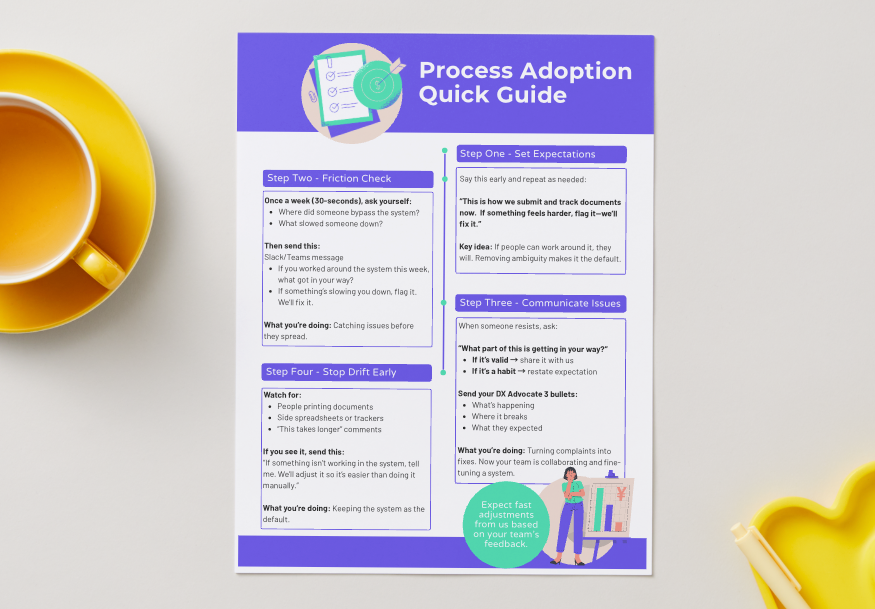
Champions shouldn’t have to figure this out on their own. If you’re in that role—or assigning someone to it—having the right tools and language makes a big difference.
Download our Practical Guide for Process Champions for scripts, red flags to watch for, and simple ways to reinforce the process without creating friction.
When something feels off, most users won’t report it. They’ll work around it—not because they don’t care, but because it feels like extra work, they don’t expect anything to change, or they don’t want to look like they’re struggling.
You have to make feedback easy:
Speed matters more than perfection. A quick response builds trust faster than a perfect fix delivered too late. When people see their feedback lead to real changes, they start speaking up more. That’s what keeps your system alive and improving.
Onboarding is a system and a cycle that repeats often. Turnover, role changes, and simple forgetfulness are part of normal business life. If you treat training as one-and-done, your process will slowly erode.
Instead, reinforce adoption over time through short refreshers, role-based reminders, and quick recaps when a process changes or someone returns after time away. The goal is not to retrain people from scratch each time, but to keep the process familiar and easy to follow.
Leaders often know the risks of inconsistent processes, but they may hesitate to push too hard because they don’t want to create tension. If adoption issues are invisible, they’re easy to ignore.
Passive visibility helps solve that problem by showing where adoption is slipping, where workarounds are increasing, and where risk is building without turning the conversation into blame. When leaders can clearly see what’s happening, they can support consistency without feeling like they’re disrupting culture.
“Support” feels like filing a ticket and waiting. “Partnership” feels like solving problems together. If users think they’re entering a queue, they won’t reach out. If they feel like they have a partner, they will.
Regular check-ins make it easier to surface friction before it turns into abandonment, and fast follow-up helps people feel heard. Over time, that makes the relationship stronger and the process more durable.
The goal is simple: when something doesn’t work, your team’s instinct should be to bring it forward—not work around it.
A process that feels easier today can still cost more tomorrow. Saving a few seconds by bypassing the system may seem harmless, but that habit can create delays, errors, missing records, and audit problems later on. The cost is not always visible right away, which is exactly why it tends to grow.
Turnover makes this even more fragile. New employees don’t know the process. Experienced ones may drift back into old habits if no one reinforces the standard. Adoption is not a one-time event—it’s something that has to be maintained.
The real shift is moving from “we implemented the system” to “we actively manage how work gets done.” That means treating document management as an operating discipline, not a software project that ends after it’s live.
When the process is clear, visible, and reinforced, employees are more likely to trust it. And when they trust it, they use it. That is what turns document management from a source of friction into a real business advantage.
This is where the right system makes a difference—by making the better way of working easier to see, follow, and maintain over time.
Platforms like DocuXplorer are designed to support that kind of clarity and consistency—giving teams one place to work, leaders visibility into what’s happening, and champions the tools they need to keep everything moving forward.
Because the goal isn’t just to implement document management. It’s to stay in control of it. If you’re not actively managing your process, your team’s habits will manage it for you.



.png)